Next.js Website and Web Application Development
We build websites, catalogs, ecommerce projects, customer portals, and web applications. Architecture, content management, integrations, technical SEO setup, and deployment are handled within one project.
What we build with Next.js
Next.js is not limited to web applications. It can power a focused landing page, a large catalog, or an ecommerce project when the build needs custom logic, independent content management, or room to grow.
Landing pages
Focused pages with custom presentation, interactive elements, integrations, and room to expand.
Company websites
Multi-page websites with services, articles, multiple languages, and content management for internal teams.
Catalogs
Projects with many categories, filters, attributes, dynamic pages, and external data sources.
Ecommerce
Custom storefronts with catalogs, carts, payments, customer accounts, and connected systems.
Portals and web applications
Customer accounts, internal tools, dashboards, and projects with custom business logic and access roles.
Next.js development pricing
Landing Page
A single page built for one offer, product, or event — the goal is conversion into a lead.
Next.js
$1,800 – $2,300
35–45 hours
Modular architecture, animation, deploy on Vercel/Cloudflare.
SEO growth: $300 – $500 one-time
Corporate Site
A multi-page company site: services, case studies, an about section, and a blog.
Next.js
$3,500 – $4,500
70–90 hours
Content management via an API, fast client-side navigation, and Schema.org markup.
SEO growth: $1,000 – $1,500 / month (20–30 hours/month)
Catalog
A multi-level product/service catalog with filtering and cards, quote-request instead of checkout.
Next.js
$4,500 – $6,000
90–120 hours
Instant client-side filtering, fast at large data volumes.
SEO growth: $1,500 – $2,000 / month (30–40 hours/month)
E-Commerce
A full store: cart, checkout, account area, and payment processing.
Next.js
$6,000 – $8,000+
120–160+ hours
Custom checkout, webhooks, isolated data layer.
SEO growth: $2,000 – $2,500+ / month (40+ hours/month)
Web applications and custom projects are estimated individually
The ranges above cover common website formats. A customer portal, internal system, web application, or another project with custom business logic does not have a useful standard price. We estimate it from the required interfaces, roles, data, integrations, and acceptance criteria.
What Next.js development includes
The scope follows the project. We can deliver the complete build or take responsibility for a defined part of an existing system.
Project architecture
Plan pages, routes, data, components, and the right rendering and update strategy for each area.
Interface and responsive build
Build from supplied designs, references, or an agreed prototype and check core flows across desktop and mobile.
Content management
Add a CMS when editors need to manage pages, services, articles, products, translations, or metadata without code.
Integrations
Connect APIs, forms, CRM, Telegram, payment providers, and other approved external systems.
Technical SEO foundation
Set up metadata, sitemaps, indexing rules, Schema.org, and a sound structure for multilingual projects.
Deployment
Prepare the build, environment variables, and launch process for infrastructure that fits the project.
Manage website content without touching the code
A CMS is added when the website needs regular content updates. Editors get a separate interface for pages, services, articles, products, translations, and SEO fields.
Before development, we define which data should be editable, how the records relate to one another, and where they appear on the website. This matters most for catalogs, multilingual projects, and websites expected to grow over time.
A separate content system may be unnecessary when the project rarely changes. We decide this after reviewing the task instead of adding a CMS by default.
When Next.js fits the project
Next.js is useful when a standard website build is too restrictive or the project is expected to keep developing after launch.
The website will keep expanding
New sections, functions, languages, or user flows are already planned.
The project has custom logic
The build includes accounts, user roles, calculations, complex forms, or individual workflows.
The catalog is large
The website needs many categories, filters, attributes, and dynamically generated pages.
Data comes from several systems
The project exchanges data through APIs or connects to CRM, payments, databases, and other platforms.
A separate team manages content
Editors and marketers need control over content without access to the technical layer.
The website serves several languages
Each language or region needs its own pages, metadata, and indexing structure.
Next.js or WordPress
Both platforms are valid. The right choice depends on the project rather than the popularity of the stack.
Next.js
- Custom logic, complex interfaces, and frequent product development.
- Large catalogs and connections to several data sources.
- Architecture tailored closely to the project.
WordPress
- Company and content websites with standard CMS logic.
- Faster and less expensive launch for common requirements.
- A broad range of proven features available out of the box.
We work with both platforms. If WordPress solves the task more sensibly, we will not complicate the build just to use Next.js.
A new build or further development of an existing project
We can build a new Next.js project, rework an existing website, or add a defined set of functions.
Before changing an existing project, we review its code, architecture, dependencies, and access. This shows which parts can stay and which are safer to rebuild. The scope cannot be estimated accurately from the visible website alone.
For a migration, we plan pages, content, data, URLs, and redirects separately. If the project already runs on Next.js, we can add new sections, a CMS, integrations, or user flows.
How Next.js development works
Review the task
Define who will use the project, the actions they need, the data sources, and the systems to connect.
Confirm the structure and scope
List pages, functions, integrations, and acceptance criteria. Use supplied designs, references, or an agreed prototype.
Design the architecture
Plan routes, data models, components, content management, and deployment.
Build the project
Implement the interface, business logic, and approved external connections.
Add content and settings
Load the agreed content, metadata, languages, and technical configuration.
Check and launch
Manually check core pages, links, forms, and flows on desktop and mobile before deployment.
A foundation for continued development
Pages use reusable components, which makes it easier to add sections while keeping the interface consistent.
Rendering is selected for each type of page. Content pages, catalogs, customer accounts, and interactive features may need different technical approaches. Data structures and integrations are also planned early so a new language, data source, or user flow does not automatically require rebuilding the working parts of the project.
Future work still needs a separate estimate. No architecture can account for every later feature or guarantee that technical debt will never appear after further changes.
Why impik.dev
Development follows the website structure
We consider the content, search demand, links between sections, and the actions visitors need to take.
Development and content work together
Development, SEO, copywriting, and technical setup can be coordinated within one project.
The platform follows the task
We build with both Next.js and WordPress and compare the options by cost, capability, and maintenance.
Work can continue after launch
The project can be handed over after completion or developed further through ongoing support.
Experience in numbers
Since 2019
Building, improving, and promoting websites for businesses
100+
Projects completed across development, SEO, content, and integrations
5 years
Longest ongoing client relationship
Continue developing the project after launch
We correct defects in the agreed implementation for 30 days after launch. New functions, changed requirements, and issues caused by changes in external services are estimated separately. Next.js Care can monitor a project that needs continued oversight. Regular development packages cover new sections, integrations, and other planned work.
Next.js development questions
Next.js is a React framework for websites and web applications. It supports several rendering approaches, server-side logic, external data, and complex interfaces.
No. WordPress may be faster and less expensive for a standard company or content website. Next.js is useful for custom logic, integrations, large catalogs, and projects expected to evolve.
Yes, when the project needs a CMS. We define which pages and data should be editable and provide a separate content interface.
Yes. We can build accounts, portals, dashboards, and other business logic. The scope depends on requirements, user roles, and connected systems.
Yes, when the selected service provides a suitable integration method. We review its API, documentation, plan, and required access before estimating the work.
Full custom UI/UX design is not part of standard development. We usually work from supplied designs, references, or an agreed prototype. A specialist designer can be engaged separately.
The schedule depends on unique pages, business logic, integrations, and the readiness of design and content. We confirm it after estimating the project.
Landing pages are generally $1,800–$2,300, company websites $3,500–$4,500, catalogs $4,500–$6,000, and ecommerce projects from $6,000. Web applications and custom systems are estimated individually.
Yes, after reviewing the code, dependencies, architecture, and access. We first identify what can stay and what needs rebuilding.
The choice depends on the architecture and the client’s infrastructure. We can work with an existing setup or recommend a suitable option after technical review.
Yes, when rendering, metadata, internal links, and page structure are implemented correctly. We prepare the technical foundation for indexing but do not promise rankings or indexing dates.
We correct defects in the agreed implementation for 30 days. The project can then be maintained independently or continued through Next.js Care or a development package.
Projects Developed on Next.js

Building a Cleaning Company Website Around Search Demand
For a new cleaning company in Dubai, we researched search demand, grouped the queries into clusters, and used them to design the website structure.
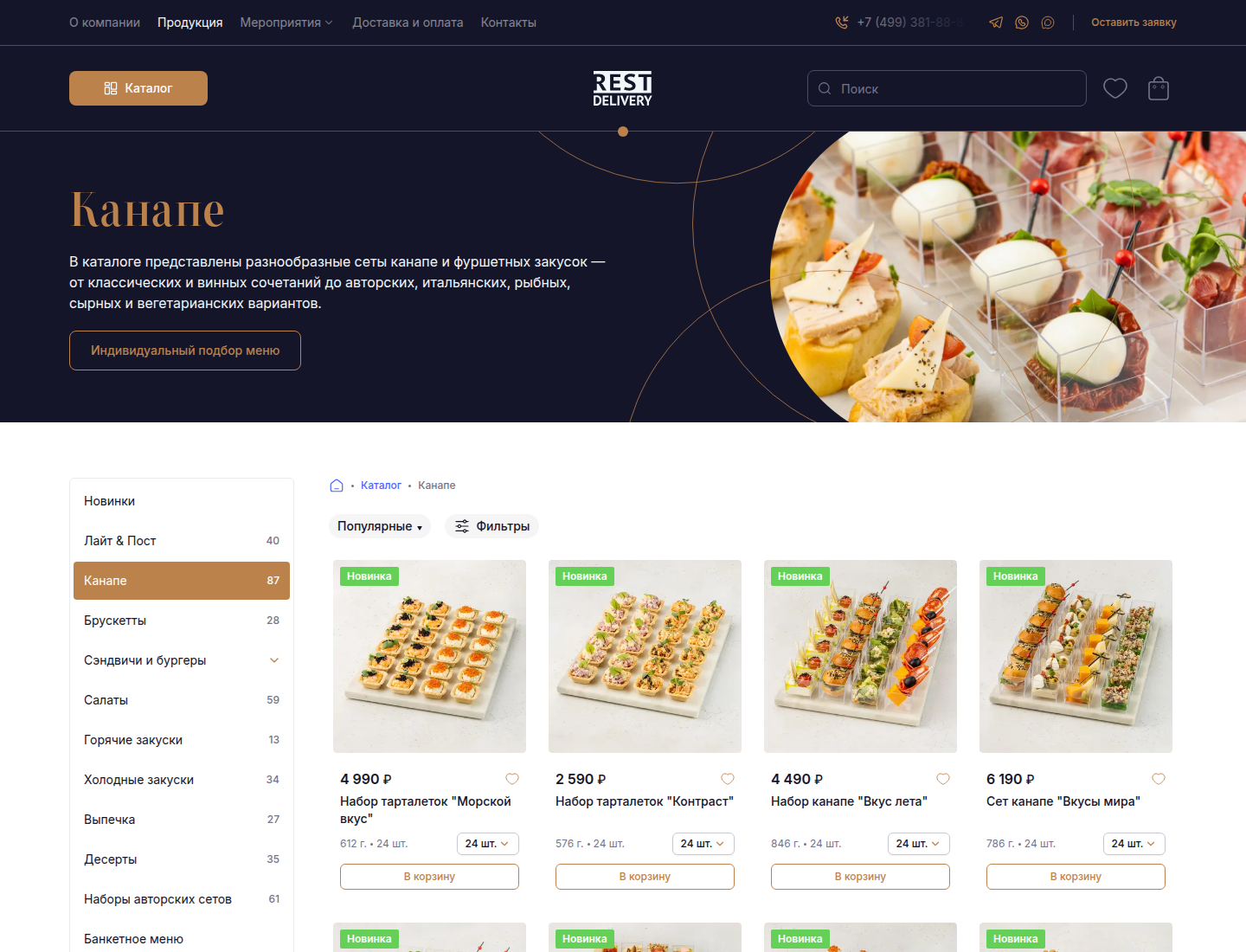
A Catering Catalogue with Flexible Menu Selection
For a premium food delivery and catering company in Moscow, we developed a catalogue that lets customers choose menus by category, event, number of guests, and service format.
Tell us what you need to build
Send a short brief, a link to the current website, or any available designs. We will review the requirements, propose an architecture, and estimate the work.